

Motivation The recognition bottleneck
AI is brilliant at solving problems that are already framed, and there is a reason. The training that makes reasoning models strong rewards checkable answers: code that runs, math that comes out right, puzzles with a known solution. Clean, symbolic tasks are exactly what they are optimized on.
But that is not how real work arrives. Users do not always hand over a problem statement and a test to pass; they describe a situation and trust the model to find the structure inside it. The skill we train for and the skill we actually need pull apart — and the gap shows up first as recognition. Before a model can solve the problem, it has to recognize what problem it is solving.
A desparate student sends a message before a deadline:
I still have to finish experiments to get results, then make figures from the numbers. My advisor needs a day to review. The submission deadline is Monday. Are we cooked? 🤯
Buried in that message is a precise question: the longest path through a weighted DAG: the critical path that decides whether Monday is achievable. Decently good LLMs could compute it in an instant, if it recognized that this is what is being asked. That "if" is the whole problem.
This kind of recognition appears everywhere.
The model may already know the relevant procedure. The harder question is whether it can recognize when that procedure applies.
This recognition step is central to human intelligence and scientific advancement. A scientist does not just calculate; they notice that a messy phenomenon instantiates a known mechanism. An engineer does not just optimize; they recognize that a vague failure report is really a caching problem. A manager does not just schedule; they know that a launch plan is a critical-path problem.
This also explains why modern agent systems rely on skills and harnesses. Skills are useful because they make procedures explicit. That is powerful. But it also reveals the bottleneck: skills make procedures explicit, but users do not ask from a skill menu. The agent has to infer which procedure is relevant before it can execute anything.
Can LLMs recognize learned procedures in unfamiliar representations? 🤔
Our paper studies this gap in a controlled setting. We ask whether large language models can recognize the same underlying procedure when it appears in different representations: natural language, graphs, and code. Experiments in a toy setting like this cleanly isolate the recognition question, and shed light on the next bottleneck in AI reasoning: the recognition problem.
Experiment & Findings Same procedure, different representation
We test recognition in a controlled setting of asynchronous planning tasks represented in natural language, graphs, and code: the underlying procedures are equivalent, but the surface representations differ. We train models including Qwen2.5, Llama-3, Olmo-2 families across scales on one representation using GRPO, SFT, distillation, and STaR, and then evaluate on all representations.
We ask: when models are trained on one representation, do they recognize the same procedure in another?
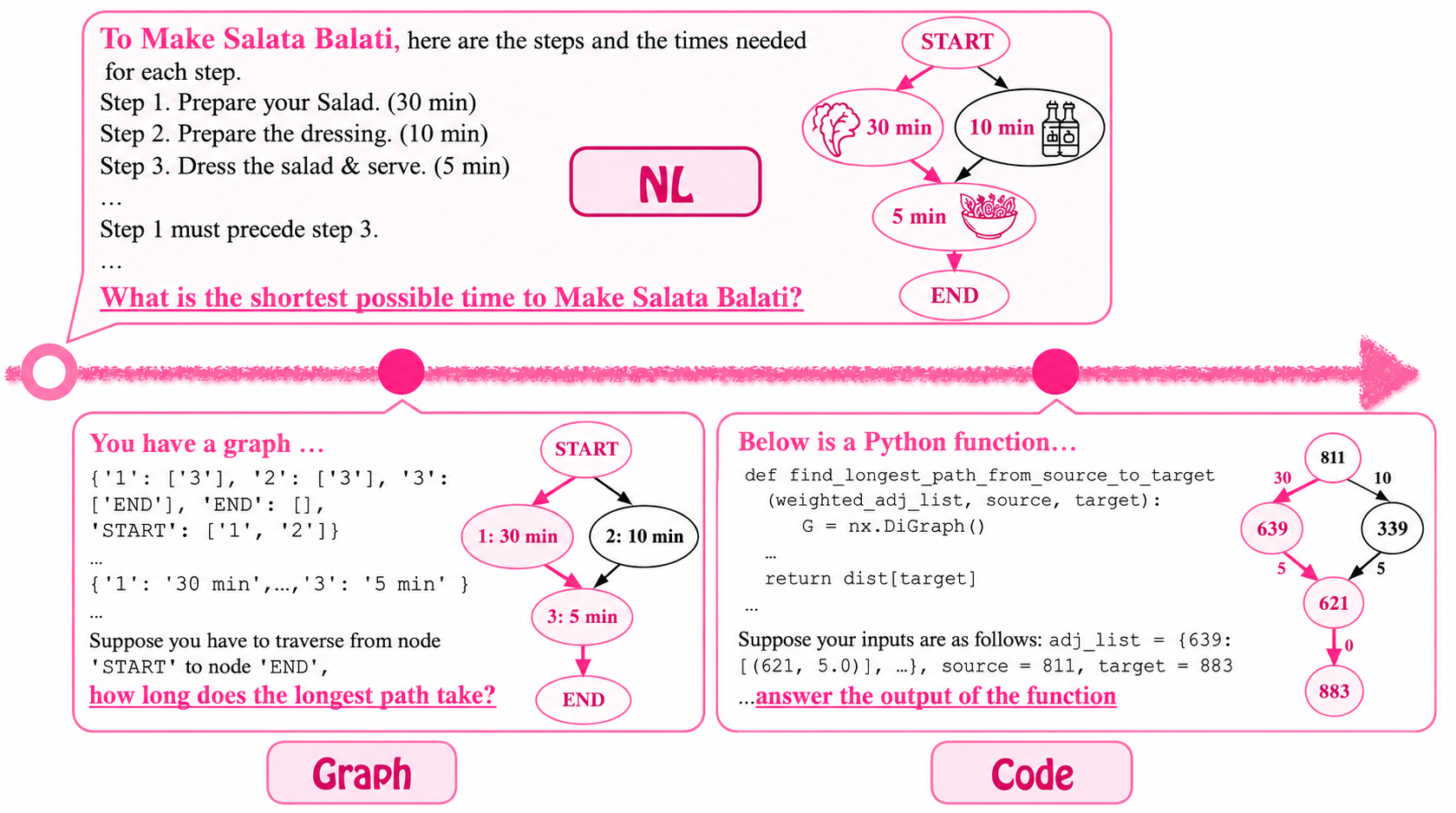
Key Finding · 1 LLMs often learn the surface representation before the procedure. 📝
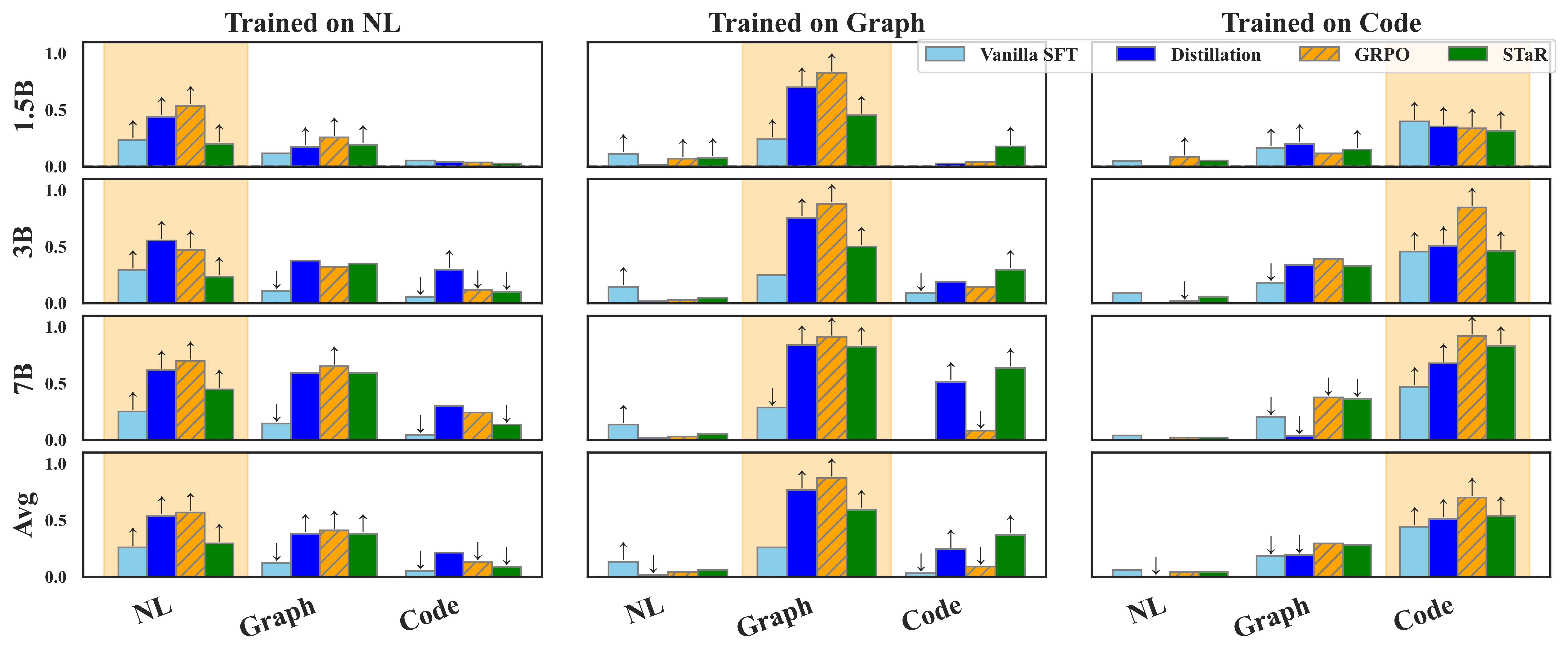
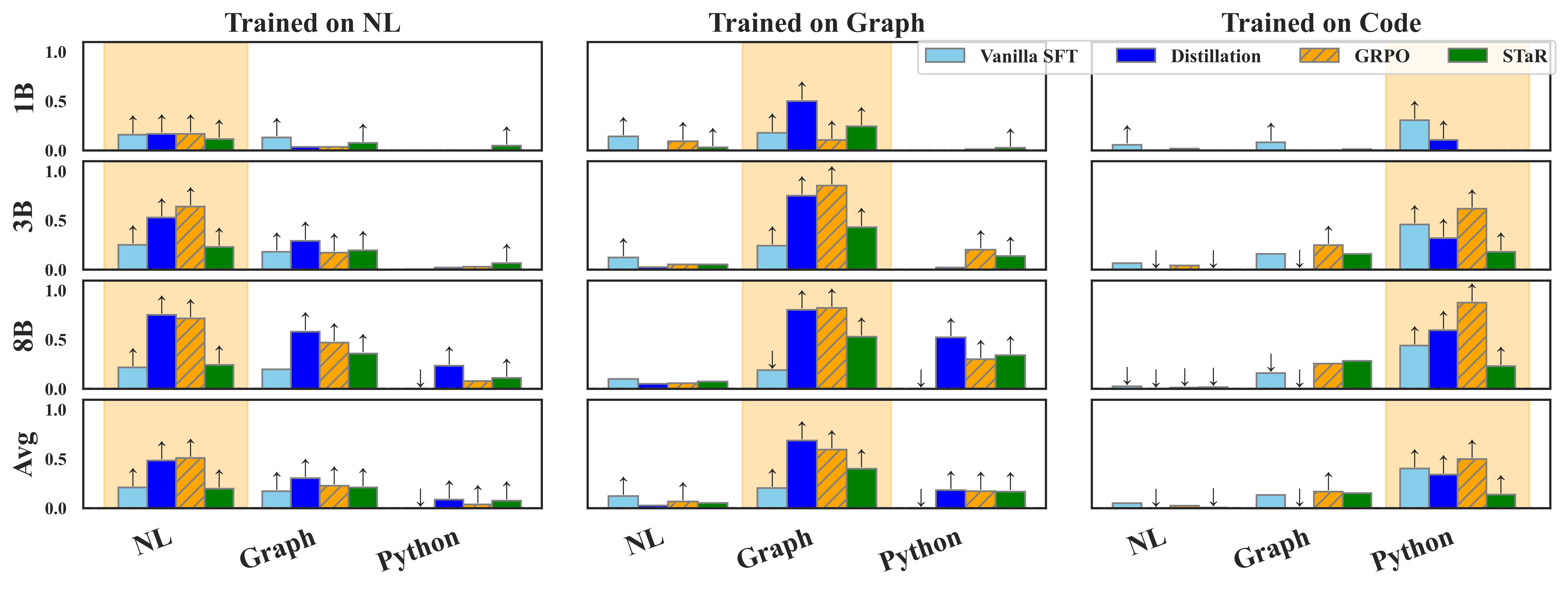
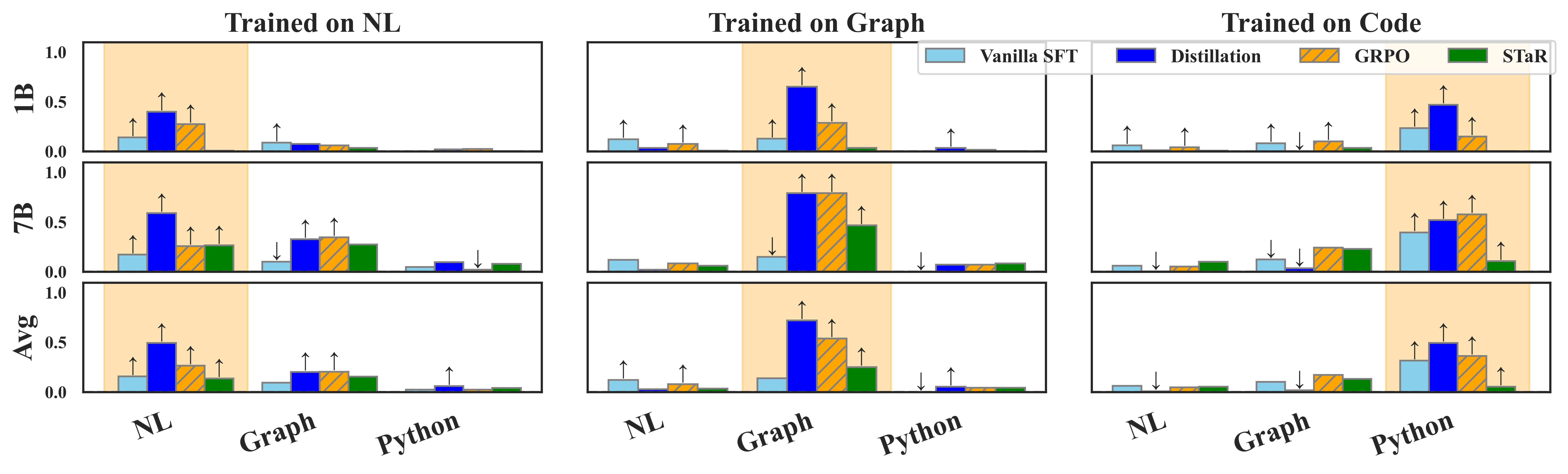
Popular post-training methods improve performance in the representation used for training. However, these gains do not reliably transfer across representations. Training on symbolic representations such as graphs or code does not reliably generalize to corresponding natural-language tasks, even when the underlying procedure is identical. The paper reports this pattern across SFT, distillation, STaR, and GRPO.
Key Finding · 2 A symbolic-to-natural RL curriculum helps bridge the gap. 🎯
We propose a symbolic-to-natural reinforcement learning curriculum: first train the model on a symbolic representation where the structure is explicit, then continue training on natural language.
Symbolic structure
Train on a symbolic representation where the structure is explicit.
Natural recognition
Continue training on natural language, where the same procedure must be inferred from a messier presentation.
This curriculum substantially improves performance across model families and tasks. In the paper, a Qwen2.5-1.5B model trained with this curriculum matches zero-shot GPT-4o on naturalistic planning, outperforming GPT-4o-mini on out-of-distribution dialectal generalization.
| Train setting | Train Acc. (NL) | Test Acc. (NL) | Test Acc. (NL-AAVE) |
|---|---|---|---|
| Graph (40 steps) + NL (40 steps) | 0.873* | 0.782* | 0.573 |
| NL (40 steps) + Graph (40 steps) | 0.504 | 0.431 | 0.169 |
| NL only (80 steps) | 0.811 | 0.698 | 0.507 |
| 3B (NL 40 steps) | 0.556 | 0.471 | 0.400 |
| 7B (NL 40 steps) | 0.753 | 0.698 | 0.573 |
| GPT-4o-mini (zero-shot) | - | 0.440 | 0.289 |
| GPT-4o (zero-shot) | - | 0.782 | 0.724 |
We also extend the curriculum to other task families: math and physics. We train models on code in these task families and then evaluate on natural language representations. We find that the curriculum improves performance on both tasks, especially on out of distribution generalization, suggesting that the recipe can support procedure generalization in other task families.
| Train setting | Test Acc. (Math) | Test Acc. (Physics) |
|---|---|---|
| Math Code (20 steps) + NL (20 steps) | 0.435 | 0.230 |
| Math NL (40 steps) | 0.385 | 0.135 |
| Physics Code (20 steps) + NL (20 steps) | 0.325 | 0.550 |
| Physics NL (40 steps) | 0.315 | 0.555 |
Key Finding · 3 Recognition is generative analogy over structure. 🔍
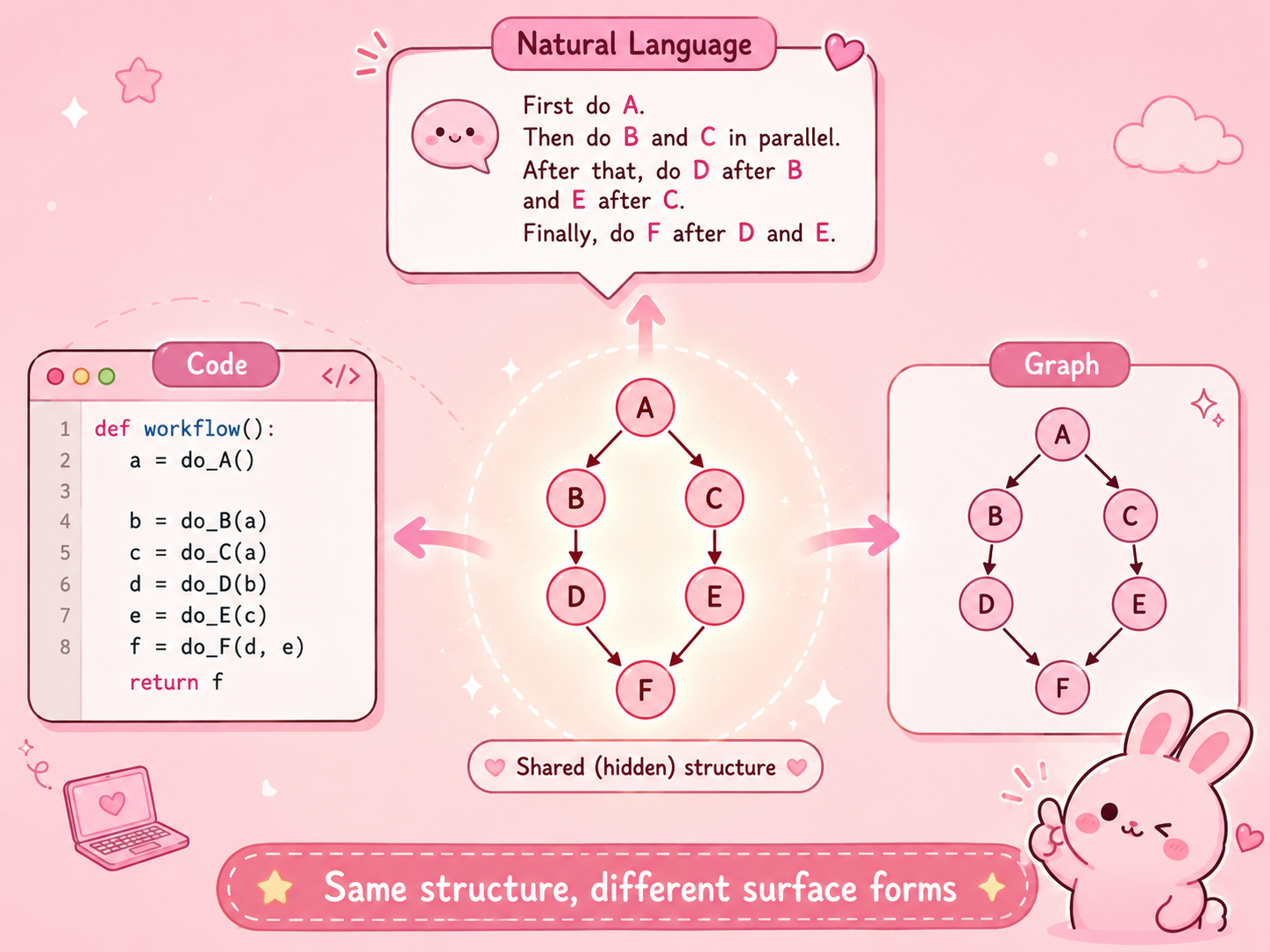
Humans excel at recognizing shared structures beneath different forms—a scientist sees a familiar principle in a new phenomenon, or an engineer maps a vague failure to a known fix. These types of recognition often demonstrate high degree of expertise and understanding of the relevant field.
When LLMs generalize, they often do so by analogical generalization. This generative analogy is closely related to human experts' ability to recognize shared structures beneath different forms.
| Hypothesis | NL → NL | NL → Graph | Graph → NL | Graph → Graph | Graph→NL → NL | Graph→NL → Graph |
|---|---|---|---|---|---|---|
| Frequency-based (rho_p) | 0.176 | 0.124 | - | 0.188 | 0.245 | 0.273 |
| Analogy-based (rho_k) | 0.242 | 0.148 | - | 0.291 | 0.265 | 0.297 |
Implications From task assistance to workflow intelligence
Post-training should shape transferrable capabilities for diverse task generalization. Curriculum is one way to guide the abstraction: first expose the procedure in a clean symbolic form, then teach the model to recognize it in natural language. First teach the procedure. Then teach the disguise.
Reliable reasoning requires more than in-domain accuracy. Reasoning benchmarks should rigorously test for transferability across representations. Change the disguise. Keep the procedure. Test what survives.
Agents should reliably adapt to different scenarios where underlying procedures are similar to what they are trained on regardless of the representation. Cross-domain discovery also requires generalization of knowledge across different areas. Recognition is the key to this adaptability.